What is a Standard?
A Standard is a guideline approved by a recognised body that provides for common and repeated use, rules, guidelines or characteristics for products, processes and production methods, with which compliance is not mandatory.
Standards can be of many types; the more common types are:
- Testing Standards
- Product Standards
- Process Standards
- Services Standards
- Management Systems Standards
Who Benefits from Standards?
Standards provide technological, economic and societal benefits:
- Businesses can offer products that meet international specifications and therefore gain market access.
- Consumers are afforded a wider choice of safe, reliable and consistent quality products.
- Governments have the scientific and technological basis for health, safety and environmental legislation.
- Trade officials can use standards to level the playing field and arbitrate trade disputes.
- For developing countries, standards represent internationally recognised best practices and could be an important source of technological know-how. Standards provide a basis a basis for making correct decisions when investing scarce resources.
- For everyone, standards improve the quality of life.
Who Benefits from Standards?
Standards provide technological, economic and societal benefits:
- Businesses can offer products that meet international specifications and therefore gain market access.
- Consumers are afforded a wider choice of safe, reliable and consistent quality products.
- Governments have the scientific and technological basis for health, safety and environmental legislation.
- Trade officials can use standards to level the playing field and arbitrate trade disputes.
- For developing countries, standards represent internationally recognised best practices and could be an important source of technological know-how. Standards provide a basis a basis for making correct decisions when investing scarce resources.
- For everyone, standards improve the quality of life.
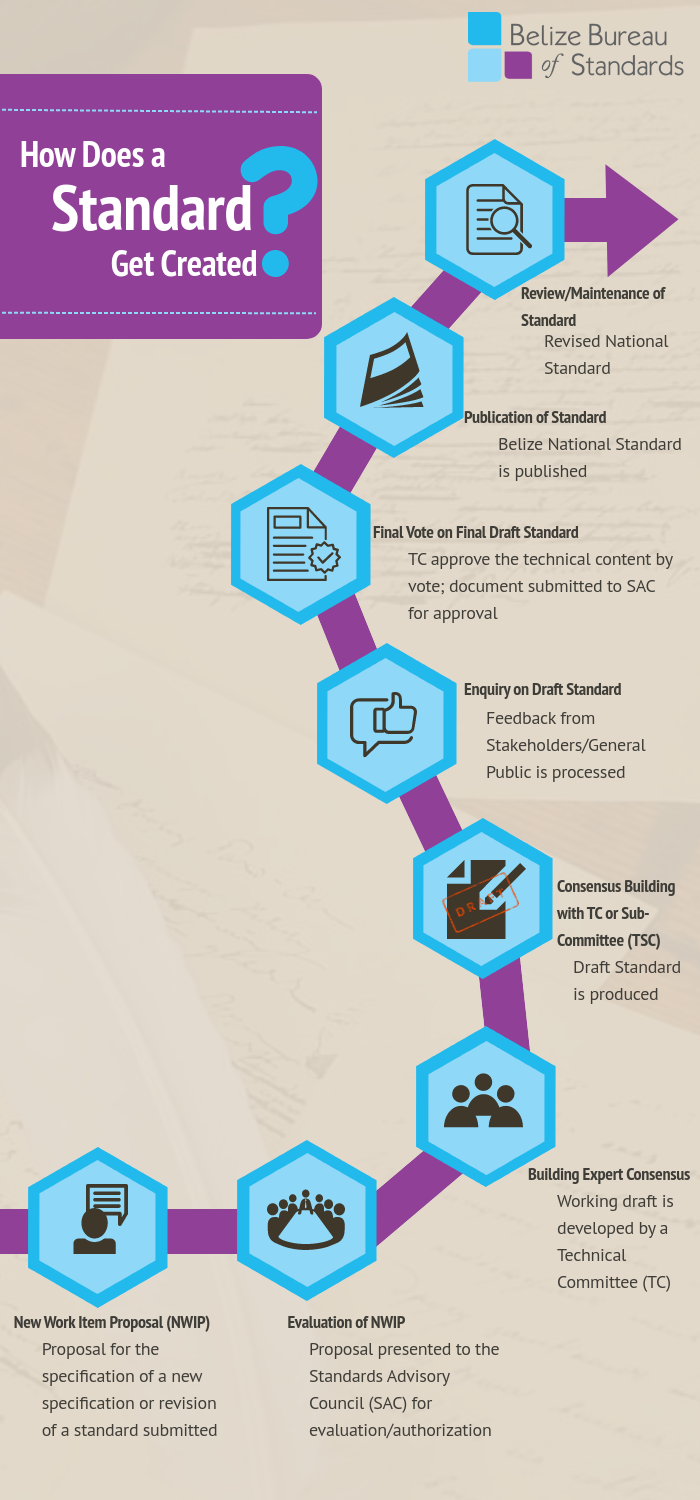
Standards Development Process
Preliminary Stage
Request received, evaluation conducted and project submitted for authorization.
Proposal Stage
The proposal is presented to the Standards Advisory Council (SAC) for evaluation/authorization and if recommended for establishment of standard then a Technical Committee (TC) or Sub-Committee is formed or the project is assigned to an existing TC.
Prepatory Stage
Working draft is developed along with the TC and a project schedule is established; This involves the collection of technical and trade data to develop working draft.
Committee Stage
Principal stage at which comments from members of the committee are taken into consideration, with a view to reaching consensus on the technical content of the standard and usually involves a number of committee meetings.
Enquiry Stage
The enquiry stage (draft for public comment) is the principal stage at which comments from the general public and stakeholders are taken into consideration; Advertisement of the standard for public comments giving a minimum of 60 days to comment on draft standards. If substantial comments received, then draft is amended; TC reaches consensus on draft, TC conducts a quality review and a pre-approval edit is completed.
Approval Stage
The TC approves the technical content of the draft document by vote and a second level review is conducted to verify that standards development procedures were followed; The document is submitted to the SAC for approval and recommendation to be established as a standard.
Publication Stage
Final edit is conducted to verify conformity with the applicable editorial and procedural requirements; At this stage it is recommended that a marketing awareness plan be established to let everyone know that a new  standard is available
Review Stage
This stage a systematic, periodic review of the standard is performed in an effort to keep it current and technically valid, if found adequate is only a need to confirm the standard and state this in the standards catalogue; May include publication of amendments, the interpretation of a standard or clause. The systematic review of all standards occurs every three years.